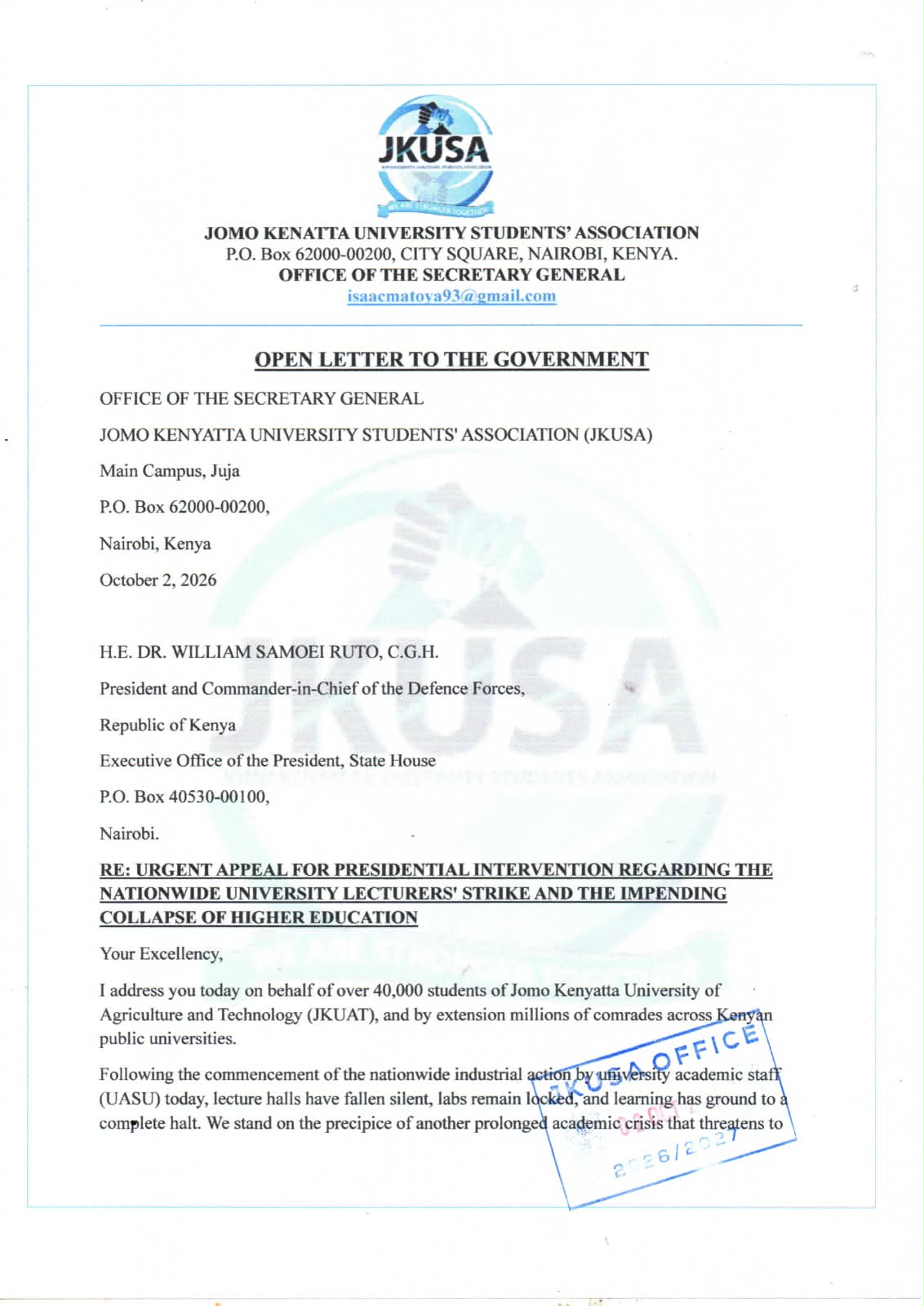
Lecture halls across Kenya's public universities have fallen silent. On 2 October 2026, the Jomo Kenyatta University Students' Association (JKUSA) through it's secretary General, Isaac Ongoto, put a formal appeal on President William Ruto's desk. It argues that while lecturers and the government fight over a pay agreement, students' constitutional right to education is being lost in the middle. This guide explains the strike, what the students are asking for, what the Constitution says, and what it means for your semester.
Quick summary: the UASU strike at a glance
- Who is on strike: members of the Universities' Academic Staff Union (UASU), the Kenya University Staff Union (KUSU) and the Kenya Union of Domestic, Hotels, Educational Institutions, Hospitals and Allied Workers (KUDHEIHA).
- When it started: 2 October 2026, after talks with the Inter-Public Universities Councils Consultative Forum (IPUCCF) collapsed on 1 October.
- What it is about: implementation of the 2025–2029 Collective Bargaining Agreement (CBA). The unions rejected a 4% annual salary increment offered by the employer side as inadequate.
- Who is affected: students in public universities, including the over 40,000 students at JKUAT whom the association says it represents
- What JKUSA wants: an emergency multi-sectoral summit, release of funds by the National Treasury, and a permanent financing model for public universities.
Why are university lecturers on strike in 2026?
The immediate trigger was a breakdown in negotiations. Media reports on 1 October said the unions and IPUCCF had reached a dead end, and the unions dismissed the 4% annual increase on the table. They insist the 2025–2029 CBA must be implemented in full.
The unions' grievances go beyond the percentage. In the notice they issued in September, UASU leaders pointed to:
- Stalled promotions and delayed gratuity payments.
- Unilateral changes to lecturers' terms through government human-resource instruments, without consultation.
- Staffing shortages. UASU claims Kenya has roughly 9,000 lecturers serving more than one million university students, which leaves existing staff overstretched. The union also wants lecturers to stop taking up part-time teaching arrangements, which it says universities use in place of hiring full-time staff.
- How lecturers are paid. UASU wants the public-officer status of university lecturers kept, and wants a clause in the Tertiary Education Placement and Funding Bill, 2026 that protects lecturers' pay through the Exchequer. It opposes any move to fund salaries from student fees or market-based income.
The unions have also said universities are in financial distress because money owed to them by the government has not been remitted.
On the other side, the government has publicly pushed back on the lecturers' position. President Ruto was reported on 2 October as saying the lecturers are raising an issue they first took to a previous administration in 2017
The JKUSA open letter: what students are asking the President to do
On 2 October 2026, the Office of the Secretary General at JKUSA, under Secretary General Isaac Ongoto, wrote an open letter to H.E. Dr. William Samoei Ruto, titled "Urgent Appeal for Presidential Intervention Regarding the Nationwide University Lecturers' Strike and the Impending Collapse of Higher Education." The letter was copied to the Cabinet Secretaries for Education and for the National Treasury and Economic Planning, and to the UASU Secretary General.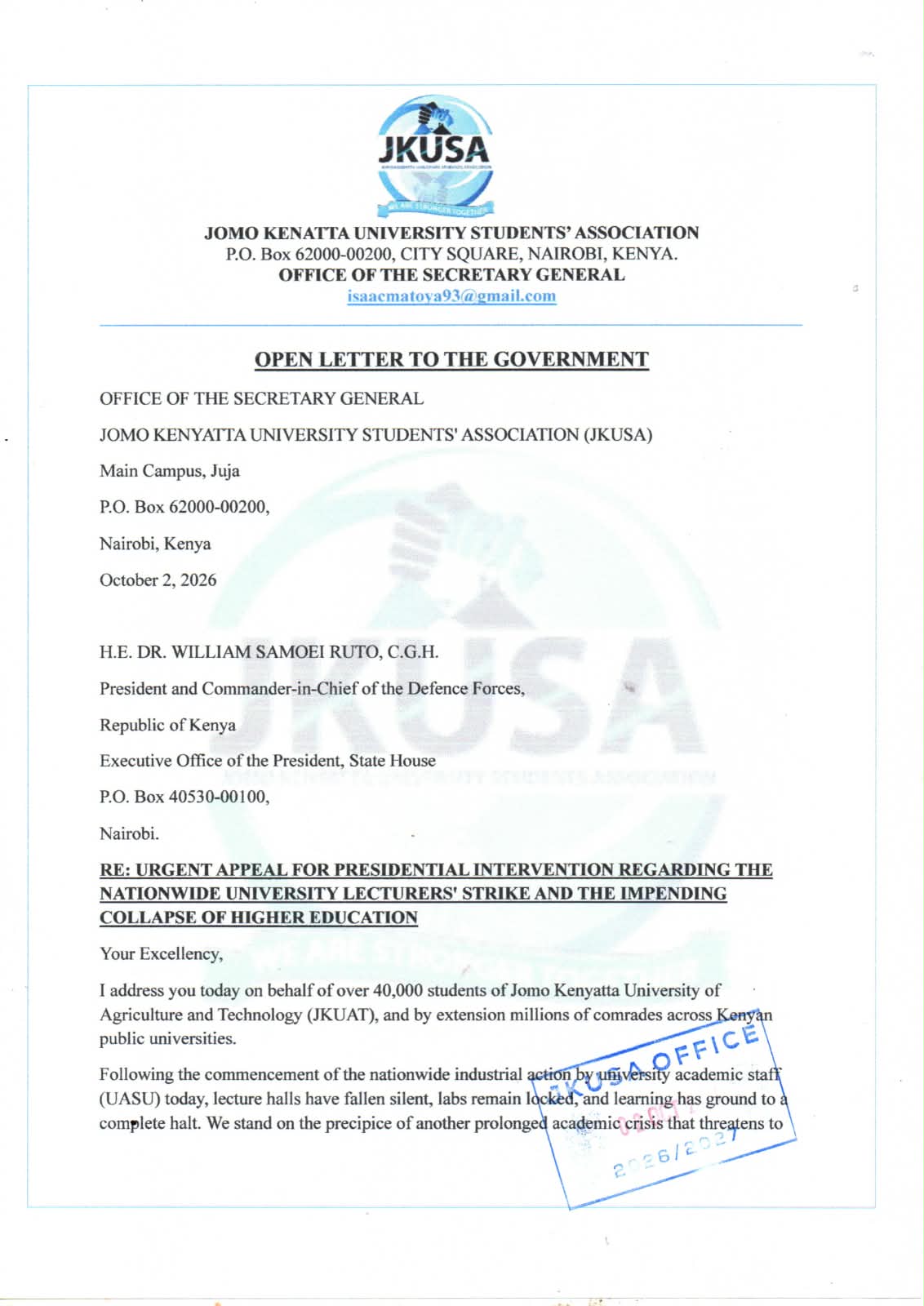
Writing on behalf of JKUAT students and, by extension, students in public universities across Kenya, the association describes lecture halls gone quiet, labs locked and learning at a standstill, and warns of a prolonged crisis that could derail academic calendars, graduation timelines and students' mental well-being.
It makes three specific requests of the President:
- Convene an emergency multi-sectoral stakeholder summit bringing together the Ministry of Education, the National Treasury, the Salaries and Remuneration Commission (SRC), university councils and UASU leadership to resolve the 2025–2029 CBA deadlock.
- Direct the National Treasury to release the budget allocations needed to fulfil the return-to-work formulas and agreements already reached.
- Establish a permanent, long-term financing mechanism for public universities, so that the cycle of closures and strikes stops recurring.
The letter's central line is that students should not be collateral damage in an industrial dispute.
What the Constitution says: students' rights and lecturers' rights in conflict
The most distinctive part of the JKUSA letter is that it treats the strike as a constitutional problem, not only a labour one. It sets out five sets of provisions of the Constitution of Kenya, 2010. Here they are in plain language.
Article 43(1)(f): the right to education
Article 43 guarantees economic and social rights, including the right to education. JKUSA's argument is that when public universities cannot operate because agreements are unfulfilled, it is the student who ends up denied this right.
Article 55: the rights of the youth
Article 55 requires the State to take measures, including affirmative action programmes, so that young people can access relevant education and training (paragraph (a)) and have opportunities to associate, be represented and participate in national life (paragraph (b)). The students' point is that long academic delays push back young people's entry into the workforce.
Article 41: fair labour practices, including the right to strike
JKUSA is careful to acknowledge the other side. Article 41 gives every worker the right to fair labour practices, fair remuneration, reasonable working conditions, and the right to join a union and go on strike. The letter notes that the failure of IPUCCF, the Ministry of Education and the National Treasury to honour signed agreements pushes academic staff into industrial action, which places two legitimate constitutional rights in direct conflict.
This is the part that makes the letter more than a complaint: it does not ask anyone to give up the right to strike. It asks the State to resolve the conditions that make a strike necessary.
Articles 10 and 232: national values and public service
Article 10 binds State organs and public officers to national values, including good governance, transparency and accountability. Article 232 sets out the values and principles of public service, including efficient, effective and economic use of resources. The students argue that the repeated pattern of unkept promises and collapsed negotiations between government agencies and university unions falls short of that standard.
How these rights are usually balanced
Kenyan law does not treat any one right as automatically cancelling another. Strikes are lawful when the statutory procedure is followed, and courts can be asked to intervene where a strike is alleged to be unprotected or where rights are being limited. In practice, this means the quickest end to the dispute is a negotiated settlement, which is why the students are asking for a high-level summit rather than court action.
Where things stand
- 1 October 2026: talks between the unions and IPUCCF end without agreement; the unions reject the 4% annual increment.
- 2 October 2026: nationwide strike begins; JKUSA delivers its open letter.
- 11 October 2026: Strike ongoig, no deal in sight.
How long could the strike last? Lessons from past disputes
Students are naturally asking how long this will go on. History offers no comfort, but it offers context:
- 2003: UASU's strike after winning a major pay increase lasted around nine months, according to union officials speaking this month.
- 2025: a nationwide university strike was in its 43rd day by 29 October 2025, with the unions vowing to continue until arrears were paid and the previous CBA was implemented.
Neither is a prediction. The current strike has its own triggers, and a settlement can come quickly if the Treasury and the employer side move. But the unions have said they are prepared for a long stand-off if the government's position does not change, so students should plan for uncertainty.
What this means for you: semester, exams, fees and graduation
The questions below are the ones students ask most. Where the answer depends on your university, check its official notices.
Will my semester be extended? Usually, yes. When teaching stops, universities typically extend the semester or compress the calendar once staff return. Dates are announced by each institution's senate, so watch official channels, not rumours.
Will I still sit my exams? Exams normally follow the resumption of teaching. Your university's notices will confirm what happens with missed teaching time.
What about graduation? Delays push graduation dates back, which affects job applications and postgraduate admissions. If you have a deadline (a scholarship, a job offer), write to your registrar early with evidence.
What about industrial attachment and placements? Check with your school or department. Some students use the strike period to complete attachments, but confirm with your department so that your hours are recognised.
What about fees and HELB? Keep all fee and HELB records, and ask your finance office how the extended period will be treated. Do not assume extra charges are automatic, and do not pay anything you cannot get a receipt for.
What can I do with the time? Self-study, revision groups, online courses, skills and projects. Keep your course materials organised so you can return to the timetable quickly.
What can students do now?
- Follow official channels only: your university's website, student portal and registrar's notices.
- Stay in touch with your class representative and student council, who are closest to developments.
- Keep records: fee receipts, HELB statements, and communication from the university.
- Keep it peaceful. Lawful, orderly advocacy is protected. Violence and property damage hurt students most.
- Look after your well-being. Prolonged disruption is stressful. Talk to friends, family, a counsellor or a trusted mentor if it is affecting you.
Frequently asked questions
Why are lecturers on strike in Kenya in October 2026? They are demanding full implementation of the 2025–2029 CBA after talks with IPUCCF collapsed, and they rejected a 4% annual salary increment. They also object to unilateral changes to their terms and to proposals that could shift their pay to student fees.
Which universities are affected? The strike is described as nationwide across public universities. Check your institution's notices for its specific status.
When will universities reopen? No date had been confirmed in the reports reviewed at the time of writing. Reopening depends on an agreement between the unions, university councils, the Ministry of Education and the Treasury. [Update.]
Is JKUAT closed? Teaching has been disrupted by the strike. For official status, refer to JKUAT's own communications. [Confirm.]
What did JKUSA ask President Ruto to do? It asked him to convene an emergency stakeholder summit, direct the Treasury to release the funds needed to honour the return-to-work agreements, and establish a permanent financing mechanism for public universities.
Which constitutional articles does the JKUSA letter cite? Article 43(1)(f) (education), Article 55 (youth), Article 41 (fair labour practices and the right to strike), and Articles 10 and 232 (national values and public service principles).
Is it legal for lecturers to strike? The Constitution protects the right to strike under Article 41, subject to the law. Whether any particular strike meets all legal requirements is a matter for the courts if challenged.
Will the semester be extended? Often, yes, once teaching resumes. Your university will announce revised dates.
The bottom line
The lecturers have a constitutional right to fair pay and to strike. Students have a constitutional right to education. The JKUSA letter's argument is that these two rights should never have been pushed into collision, and that the fix is a funded, lasting agreement, not another round of closures. Whether the President convenes the summit the students have asked for will be one of the things to watch in the coming days.
We will keep this article updated as the situation develops. Bookmark this page and share it with your coursemates.




Loading comments...