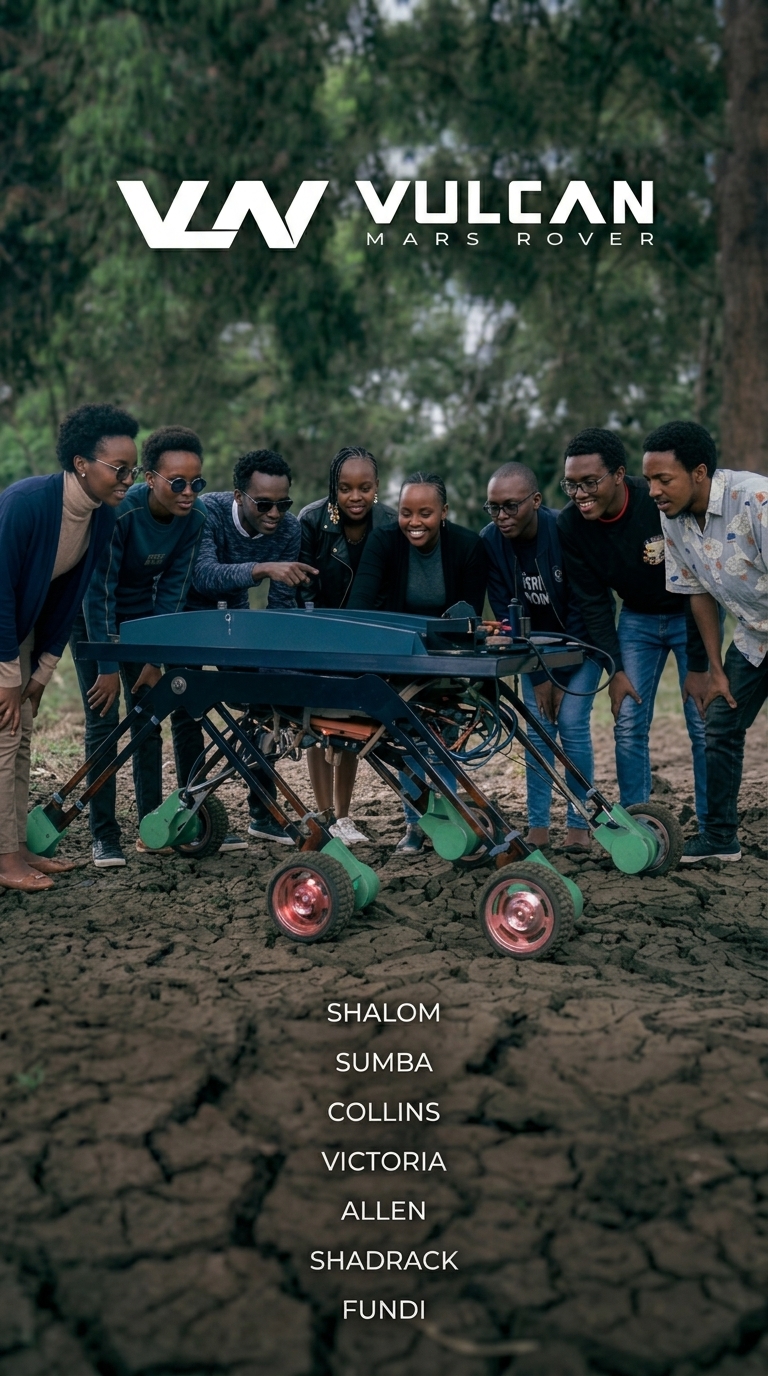
In the bustling innovation labs of College of Engineering, JKUAT a quiet revolution is taking shape; one that stretches far beyond Kenya’s borders and all the way to the dusty red plains of Mars. Eight student engineers from Jomo Kenyatta University of Agriculture and Technology (JKUAT) have achieved what once seemed impossible for a local university: building a fully functional, autonomous, wireless-controlled space rover prototype from scratch.
Operating under the name Team Vulcan, these young innovators swept the Launch Stage Final of the 2026 Cars4Mars African Rover Challenge. Outperforming more than 100 entries across the continent, the JKUAT team racked up 370 points to claim first place—surpassing South Africa’s Wall-E (341 points) and Zimbabwe’s Cyberstorm (329 points).
Their reward? A ticket to the Mars Stage Final at the South African National Space Agency (SANSA) Space Operations facility in Hartebeeshoek, South Africa, where their rover will navigate a grueling 40-ton red-sand simulator designed to mirror Martian conditions.
A Legacy Built on Student Continuity
Team Vulcan did not spring up in a vacuum. Their victory is the culmination of years of student-led collaboration and cross-disciplinary mentorship.
The project grew out of Team Jabari, an earlier university rover initiative pioneered by mechanical engineering graduate student Japheth Libese. Rather than abandoning past research when senior students graduated, JKUAT’s engineering cohort established a culture of documentation and knowledge transfer.
Team Vulcan brought together minds across multiple disciplines—combining mechatronics, telecommunications, aerospace, mechanical, and electrical engineering.
“Actual learning takes place while doing,” explains team member Collins Kiprop. “Working on a real-world system forced us to connect classroom theory with practical, high-stakes problem-solving.”
Team Lead Victoria Rotich emphasizes that the drive behind the project was as much cultural as it was technical.
“When you look online for Mars rovers and space robotics, you almost exclusively see content from Europe or Asia,” Rotich says. “Taking on this project was our way to change that narrative and show that African students belong in space exploration.”
Inside the Machine: Engineering Redundancy and Offline Autonomy
Building a machine capable of surviving an alien planet requires extreme engineering discipline. Technical Lead Brian Fundi notes that the team’s core design philosophy centered on system redundancy and decoupling.
Key technical highlights of the JKUAT Mars rover include:
-
Dual-Battery Architecture: To prevent onboard compute crashes during sudden motor spikes, the drivetrain and onboard processing units run on completely separate battery systems.
-
Offline Wireless Navigation: Built to operate in remote extraterrestrial environments, the rover functions without active cloud connectivity or public internet infrastructure.
-
Prioritized Command Protocols: The custom wireless link prioritizes critical steering commands and telemetry data over high-bandwidth video streams, maintaining control even when signals degrade.
-
Long-Range Reach: In benchmark testing, the prototype easily shattered the competition’s minimum 80-meter wireless communication requirement.
From Deep Space to Terrestrial Impact
While heading to South Africa’s SANSA facility to compete on Martian soil is the immediate goal, Team Vulcan is already looking at how their tech can solve problems back home on Earth.
The team is refining camera-based perception algorithms and autonomous obstacle detection to reduce reliance on expensive, power-heavy LiDAR sensors. University faculty and team members point out that these same systems can be adapted for:
-
Precision Agriculture: Monitoring soil quality and crop health across expansive farm holdings.
-
Mining & Geological Surveys: Mapping dangerous underground shafts without exposing workers to hazard.
-
Automated Logistics & Security: Powering indoor warehouse transport vehicles and autonomous perimeter security patrols.
For Victoria Rotich and her teammates, the ultimate goal isn't just winning a trophy in South Africa—it's embedding a lasting institutional pipeline at JKUAT.
“Our major goal is to build a lasting culture at JKUAT where students consistently enter and excel in the Cars4Mars competition year after year,” she reflects.
With their launch stage victory in the books, JKUAT's young engineers have proven that the road to Mars can run right through Kenya.
How JKUAT Engineering Students Built Project Legacy This video features leaders from the Society of Engineering Students at JKUAT discussing student-led technical initiatives, engineering documentation, and the culture of hands-on innovation that powers projects like the Mars rover.



Loading comments...